



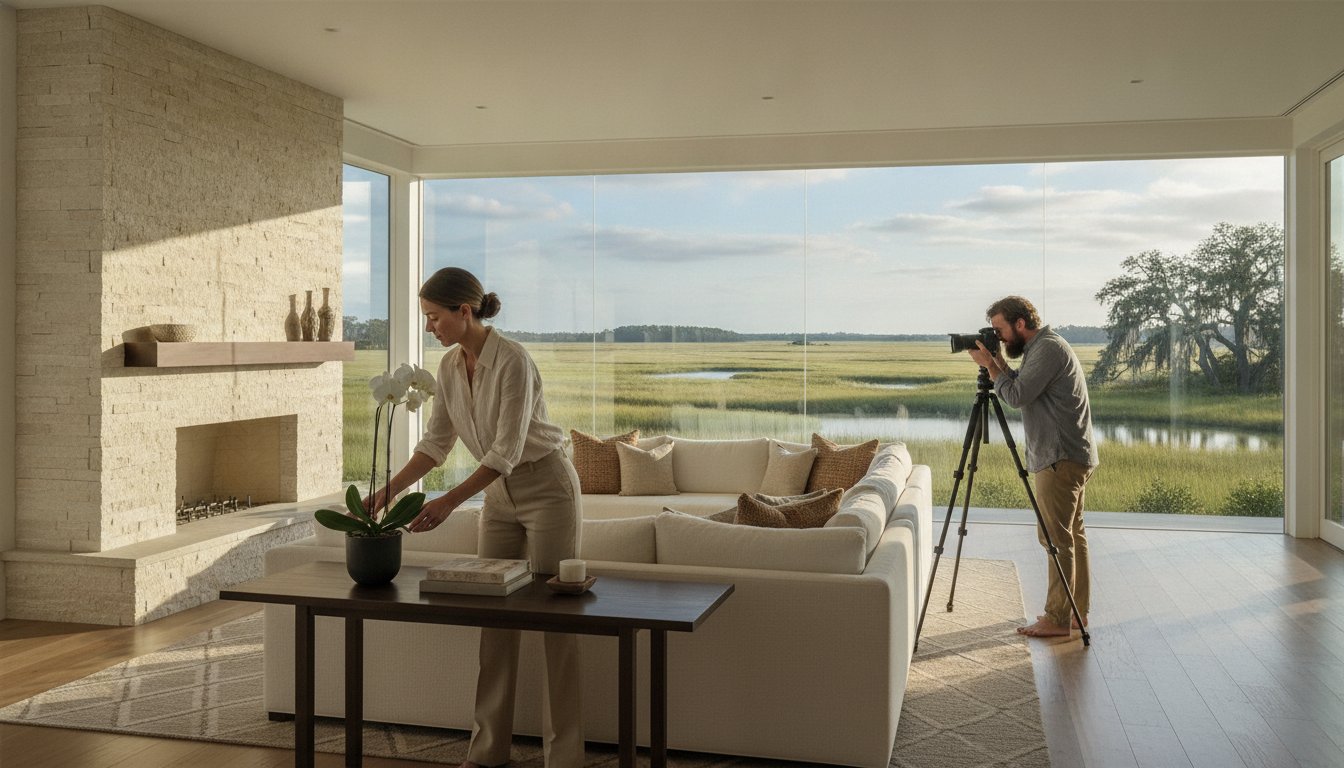
The difference between a mere digital record and a legacy portfolio piece is rarely found in the camera lens; it is found in the hours of meticulous restraint applied before the shutter clicks. For professionals in Hilton Head and Beaufort, the stakes are exceptionally high. You've spent months obsessing over the weight of a linen drape or the specific movement in a slab of natural stone. The anxiety that a photograph might fail to capture that tactile reality is a valid professional concern. Mastering how to prepare for interior design photography is the essential bridge between a completed project and a published masterpiece.
We agree that the transition from a lived-in home to a magazine-ready set is a delicate operation. You want the space to feel authentic and grounded, reflecting the natural light and spatial clarity that define Lowcountry architecture. This editorial guide promises to refine your pre-shoot process, ensuring your projects are captured with the architectural precision and tonal restraint they deserve. We will examine the logistics of homeowner coordination, the art of subtractive styling, and the technical preparation needed to produce a portfolio that resonates with high-end clients and establishes long-term professional authority.
Key Takeaways
• Define a clear narrative and identify high-impact hero shots before the session to ensure every image serves your specific portfolio or publication goals.
• Master the essential steps of how to prepare for interior design photography by prioritizing spatial clarity and removing the visual noise that distracts from architectural integrity.
• Leverage the nuances of Lowcountry light by tracking the sun's movement to illuminate coastal rooms and waterfront views with authentic, natural sophistication.
• Adopt an editorial approach to styling that focuses on restraint, using organic textures and local greenery to suggest a lived-in feel without overcrowding the frame.
• Establish a seamless shoot day through meticulous logistics and a calm, professional environment that allows for deep creative collaboration between designer and photographer.
The Strategic Foundation: Pre-Shoot Consultation and Vision
The success of an editorial shoot depends on the clarity of the pre-shoot dialogue. Understanding how to prepare for interior design photography begins with a fundamental question: what is the ultimate purpose of these images? A shoot designed for a national design competition requires a different lens than one intended for a firm's digital portfolio or a high-end publication. Establishing this narrative early allows the photographer to prioritize certain perspectives. This might mean capturing the grand sweep of a Great Room in a Palmetto Bluff estate or the intimate craftsmanship of a custom-milled library in Beaufort. Every frame must serve the story you've built over months of design and construction.
Defining Your Portfolio Goals
Your firm’s brand identity should dictate the visual style of every frame. While a standard real estate listing aims to show every square inch of a room, professional property photography focuses on the intentionality of the design. Select three to five critical angles per room that highlight your specific interventions. This approach ensures you capture the nuances of craftsmanship rather than just an inventory of furniture. It's about quality over quantity. This distinction is what separates an editorial portfolio from a basic sales gallery.
The Designer-Photographer Partnership
A strategic partnership relies on technical transparency. Sharing floor plans and site orientations allows the photographer to map the sun's path across a waterfront property. This ensures the shoot schedule aligns with the most flattering natural light available. This collaboration is also the time to discuss material finishes. Highly reflective surfaces like polished marble or Venetian plaster require specific lighting strategies to manage glare without sacrificing texture. By adhering to foundational Architectural photography principles, the team can move beyond commercial realism toward a refined editorial aesthetic. This shared vision protects the architectural integrity of the work while elevating the final presentation.
Achieving Spatial Clarity: The Art of Decluttering
If the strategic foundation is the blueprint, decluttering is the site preparation. Achieving spatial clarity is a subtractive process. It requires removing visual noise that disrupts the eye's path through a room. Items like remote controls, tissue boxes, and excessive family photographs might make a house feel like a home, but they act as anchors that tether an editorial image to the mundane. For professionals in the private club communities of Hilton Head and Bluffton, the goal is to present a vision of aspirational living, not a record of daily habits. Every object left in the frame should feel intentional and curated.
Cord chaos is the enemy of a clean line. Unplug small appliances and hide power strips behind furniture or within cabinetry. You must also evaluate the furniture layout from the perspective of the lens. Often, a chair that's perfectly placed for conversation creates a visual block in a photograph. Don't be afraid to shift heavy pieces to open up sightlines. Professional luxury real estate photography relies on these micro-adjustments to translate three dimensional craftsmanship into a two dimensional masterpiece. Clean all glass, mirrors, and stainless steel surfaces meticulously. Professional lenses are unforgiving, and a single smudge on a polished range hood can become a distracting focal point in post production.
The Kitchen and Bath Checklist
Kitchens and bathrooms require a clinical level of preparation. Clear counters of everything except one or two high quality, purposeful items, such as a sculptural mortar and pestle or a single branch in a vase. One of the most overlooked aspects of how to prepare for interior design photography is lighting consistency. Ensure every light bulb in a suite shares the same color temperature, typically measured in Kelvin. Mixed lighting creates muddy, distracting color casts on white cabinetry and stone surfaces. In the bath, remove all mats and personal toiletries. These tips for shooting interiors reinforce that removing domestic clutter allows the tile work and plumbing fixtures to take center stage.
Managing Personal Items and Homeowner Logistics
Request that homeowners and pets vacate the property to allow for total creative focus. Their presence often creates a subtle pressure that can rush the styling process. Designate a hidden zone, such as a garage or a secondary bedroom, for stowing moved items and equipment cases. This keeps the work zones clear and allows the photographer to move quickly between angles. Spatial clarity is the prerequisite for architectural integrity because it allows the designer's intent to remain the sole focus of the viewer's attention without the distraction of daily life.
Mastering the Lowcountry Light: Timing and Environment
Light is the fundamental medium of architectural media. In the South Carolina Lowcountry, the atmosphere possesses a specific weight and color that changes with the tides and the humidity. Mastering how to prepare for interior design photography requires a deep respect for what we call Natural Light Sophistication. This approach uses ambient light to reveal form and texture without the artificial distortion of heavy flash or the muddy look of overprocessed HDR. It's about capturing the authentic glow of a waterfront morning or the soft, directional light that filters through a historic Beaufort porch. When done correctly, the light does more than illuminate; it describes the craftsmanship of the space.
Window treatments are a critical, yet often overlooked, component of light management. Every blind, shutter, and curtain must be functional and uniform across the entire room. If one slat is crooked or one curtain is pulled tighter than the others, the architectural symmetry is broken. Set all treatments to a consistent height and angle before the photographer arrives. This preparation allows the creative team to focus on the nuances of the light rather than correcting mechanical errors. This level of detail is a hallmark of professional property presentation in the luxury market.
Sun Tracking for Hilton Head and Bluffton Properties
Properties in private communities like Sea Pines or Palmetto Bluff are often nestled within dense maritime forests. These ancient live oaks and towering pines create complex, dappled shadow patterns that shift rapidly. Use sun tracking apps to identify the precise window when light penetrates the canopy to hit your primary living spaces. We prioritize natural light sophistication because it preserves the spatial clarity that flat, artificial lighting destroys. Planning for the "Golden Hour" is essential for coastal homes with significant floor to ceiling glass. This specific timing creates a warm, editorial glow that resonates with high end design publications.
Exterior and Interior Synergy
The view through a window is an intentional extension of your design. If the interior is flawless but the pool deck is covered in oak tassels or debris, the image fails to meet professional standards. Ensure the landscaping is manicured and the pool is skimmed just before the session. Coordinate with property managers to ensure no mowers or blowers are active during the shoot. Managing reflections from lagoons or outdoor water features is also a technical necessity. A bright sun bouncing off a pool can create unwanted light patterns on a ceiling. Referencing a professional Interior Photography Guide can help you understand why these external details are as vital as the indoor styling. This synergy ensures the home feels embedded in its Lowcountry environment.
Editorial Styling: Restraint, Texture, and Craftsmanship
After achieving spatial clarity through decluttering, the next phase of how to prepare for interior design photography is the strategic addition of life. Editorial styling is not about filling every available surface with objects. Instead, it is a pursuit of restraint. You want to suggest a lived-in presence without obscuring the architectural lines you've worked so hard to establish. In the luxury markets of Hilton Head and Beaufort, this means prioritizing quality over volume. Every prop should reinforce the project’s narrative, acting as a quiet companion to the design rather than a loud distraction.
Avoid the trap of flashy, "new money" aesthetics that rely on trendy or over-branded accessories. These items date an image quickly and undermine the sense of timeless craftsmanship. Focus on organic textures that resonate with the Lowcountry landscape. A hand-turned wooden bowl, a stack of linen-bound books, or a single branch of local greenery can ground a room in its environment. While staging aims to make a house look lived-in for a quick sale—a specialized service offered by the Gold Coast-based rawdesigns.au—editorial styling is the art of curating a space to reveal its deepest architectural truths through intentional composition.
Selecting Purposeful Props
Florals should be chosen with architectural intent. Instead of a generic, multi-colored bouquet, select stems that complement the room’s specific color palette and scale. Large-scale palm fronds or magnolia branches can emphasize the height of a ceiling in a coastal home without dominating the frame. Use high-end textiles like cashmere or heavy-gauge linen to add warmth to minimal, modern spaces. Layering with purpose involves using books and art to guide the viewer’s eye through the frame, creating a sense of depth and discovery. Curated art pieces should reflect the sophisticated tastes of the Beaufort and Bluffton markets, reinforcing a sense of regional authority.
The camera sees texture differently than the human eye. Surfaces must be prepared to highlight the subtle grain of white oak, the intricate weave of a grasscloth wallpaper, the soft patina of a hand-forged bronze fixture, or the impeccable paintwork of Brush Hour LLC.
The camera sees texture differently than the human eye. Surfaces must be prepared to highlight the subtle grain of white oak, the intricate weave of a grasscloth wallpaper, or the soft patina of a hand-forged bronze fixture. For custom builders and architects, capturing texture and detail is essential for a winning portfolio that communicates the quality of their execution. This level of precision validates professional referrals by proving that your firm understands the nuances of material honesty. To ensure your next project is documented with this level of visual sophistication, book an architectural media session that prioritizes editorial clarity.
Shoot Day Logistics: Ensuring a Seamless Execution
The shoot day is the final movement in a carefully orchestrated performance. Arriving thirty minutes before the scheduled start allows for a final, critical sweep of the property. This is the moment to ensure that every preparatory step, from the window treatments discussed in previous sections to the placement of organic textures, is executed perfectly. A calm, professional environment is essential. It fosters the creative collaboration required to translate a physical space into a compelling visual narrative. High stakes projects in Hilton Head and Beaufort require a level of focus that is only possible when logistics are handled with quiet efficiency. Mastering how to prepare for interior design photography concludes with this transition from planning to active execution.
Strategic workflow is enhanced by modern technology. We utilize tethered shooting to review images in real-time on a high resolution display. This allows the team to identify and correct minute details, such as a stray cable or a slightly misaligned chair, before the shot is finalized. For our partners, the Houzpics portal serves as the central hub for this collaboration. It provides a streamlined interface for scheduling, project management, and the eventual delivery of your high resolution assets. This technical precision ensures that the final images meet the rigorous standards of luxury architectural media.
The Designer’s Role During the Shoot
The designer acts as the guardian of the design’s narrative. While the photographer manages technical precision, the designer provides the editorial eye. This involves making micro adjustments to styling elements, often moving a prop by mere inches to suit the specific compression of a lens. Your role is to ensure the architectural integrity of the project remains the focus of every frame. This collaborative tension between technical execution and design vision is what produces a world class portfolio. It's a strategic partnership where the designer’s intimate knowledge of the space guides the photographer’s technical expertise.
Post-Shoot Expectations and Delivery
Editorial grade retouching is a meticulous process that prioritizes realism and tonal restraint. Unlike standard real estate media, these images require careful color grading to ensure material finishes are represented with absolute accuracy. Once delivered, these assets become powerful tools for winning more listings and attracting high end architectural commissions. Establishing a long term partnership ensures that your evolving body of work maintains a consistent, sophisticated visual identity. This consistency validates professional referrals across the South Carolina Lowcountry and positions your firm as a leader in property presentation.
Translating Design Vision into Architectural Legacy
Mastering how to prepare for interior design photography is a commitment to the same level of craftsmanship you apply to the design itself. By prioritizing spatial clarity and technical precision over trendy styling, you ensure that every project is captured with the architectural integrity it deserves. Success lies in the synergy between a clear strategic narrative and the sophisticated use of natural Lowcountry light. These elements, when combined with meticulous shoot day logistics, transform a physical space into a compelling editorial story that resonates with high end clients and publications alike.
As an architecturally literate media studio serving Hilton Head, Bluffton, and the Lowcountry since 2011, Houzpics specializes in luxury residential and hospitality imagery that validates professional referrals. Elevate your design portfolio—Book your session with Houzpics today. Your next project deserves to be documented with the same intentionality that defined its creation. We're ready to help you reveal the true soul of your work.
Frequently Asked Questions
How long does a professional interior design photoshoot typically take?
A professional interior design photoshoot typically requires a full day, ranging from four to eight hours. This duration allows for the meticulous lighting setups and styling micro-adjustments necessary for editorial grade results. Unlike high volume sessions, we prioritize the architectural integrity of each frame over a rapid room count to ensure every image meets publication standards.
Should I be present during the entire photoshoot?
You should be present to act as the creative lead and editorial eye during the session. While we manage the technical precision of the equipment, your intimate knowledge of the project's design narrative is essential for selecting the most impactful angles. Your presence ensures that every detail, from fabric drape to furniture placement, aligns with your firm's brand identity.
What is the best time of day for interior photography in Hilton Head?
The best time for interior photography in Hilton Head is during the soft, directional light of the early morning or the late afternoon Golden Hour. Coastal homes with extensive floor to ceiling glass require careful sun tracking to avoid harsh glares and blown out highlights. We plan our schedule around the sun's path to capture the natural light sophistication unique to the Lowcountry environment.
Do I need to hire a professional stager for my portfolio shoot?
You generally don't need a professional stager for an editorial portfolio shoot. We recommend a subtractive styling approach that focuses on restraint and architectural truth rather than the "filled" look typical of residential staging. Understanding how to prepare for interior design photography involves curating the space to reveal its soul, a task best handled by the designer who created the vision.
How many rooms can we realistically shoot in a single day?
We realistically capture between four and six rooms in a single day when focusing on high end editorial quality. This pace allows for the thoughtful composition and material preparation required to highlight craftsmanship. Prioritizing quality over quantity ensures that each image becomes a legacy piece for your professional portfolio rather than just a digital record.
What happens if the weather is overcast or rainy on the day of the shoot?
Overcast weather is often ideal for interior photography because it provides soft, even light without the distraction of harsh, moving shadows. If heavy rain obscures significant waterfront views or prevents necessary exterior shots, we coordinate with you to adjust the schedule. Our focus remains on capturing realistic, atmospheric imagery that reflects the true mood of the property.
Can I use these photos for both my website and social media?
Yes, you can use these images across all professional platforms, including your website and social media channels. We provide high resolution files for print and web alongside optimized crops for mobile engagement. This versatility ensures your investment in professional property photography reaches your target audience effectively across different media formats.
Is there a difference between real estate photography and interior design photography?
There is a significant difference in both intent and execution. Real estate photography is a short term sales tool designed for rapid listing turnaround and broad appeal. Interior design photography is a strategic, long term marketing investment that focuses on craftsmanship, texture, and design vision to attract high end commissions and editorial features.


